
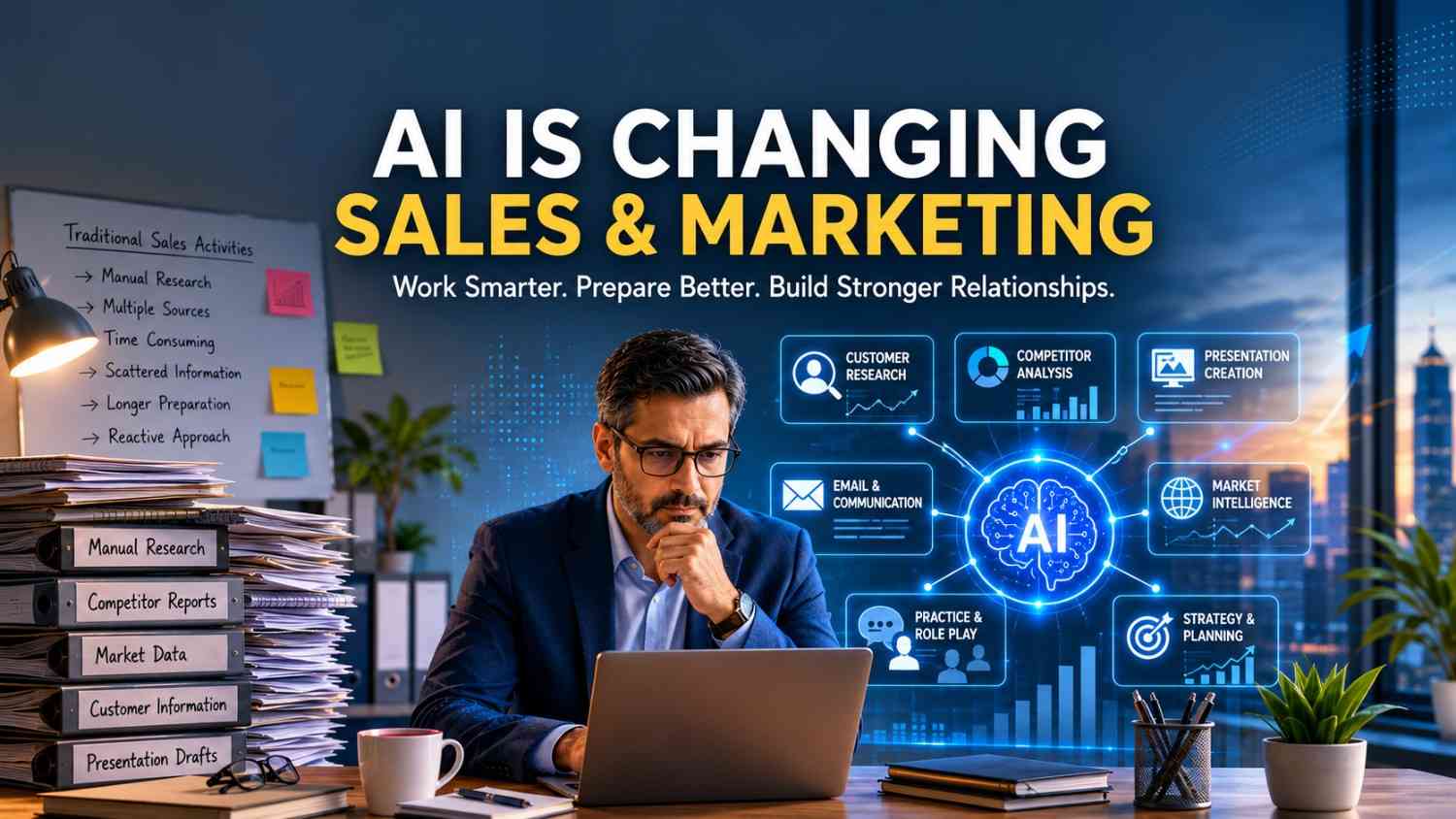
Artificial Intelligence has become one of the most talked-about technologies in recent years. Every day, we hear about new AI tools, new applications, and predictions about how AI will change the future of work.
As someone who has spent more than 20 years in sales, marketing, business development, and customer relationship management, I have witnessed many technological changes throughout my career. We saw the rise of ERP systems, CRM software, digital marketing platforms, video conferencing tools, and automation software.
Most of these technologies improved efficiency.
However, AI feels different.
It is not just another software tool. It has the potential to change how professionals learn, prepare, communicate, analyze information, and make decisions.
I started using AI seriously towards the end of 2024 and began exploring its capabilities in greater depth during 2025. Since then, it has become a valuable part of my daily professional activities.
Why AI Caught My Attention
Like many professionals, I initially viewed AI as a tool for generating content and answering questions.
However, the more I experimented with it, the more I realized its true value lies in improving productivity and accelerating learning.
One of the biggest challenges in sales and marketing has always been preparation.
Before an important customer meeting, a sales professional typically spends time researching the company, understanding the industry, studying competitors, reviewing past interactions, and preparing discussion points.
All of these activities are important, but they are also time-consuming.
AI has significantly reduced the time required for many of these tasks.
Instead of spending hours searching through multiple websites and reports, professionals can now gather and organize relevant information much more efficiently.
From Days to Hours: The Presentation Revolution
One of the areas where AI has made the biggest impact on my work is presentation preparation.
There was a time when creating a customer presentation could easily take one or two full days.
Information had to be collected manually. Content had to be drafted, refined, and reorganized. The overall structure often required multiple revisions before it was ready for presentation.
Today, much of that initial work can be completed within a few hours.
AI can help organize ideas, create presentation outlines, suggest content structures, summarize technical information, and improve the overall flow of the presentation.
This does not eliminate the need for professional judgment. The final presentation still requires industry knowledge, business understanding, and customization.
However, AI dramatically reduces the time spent on repetitive tasks.
The result is more time available for strategic thinking and customer preparation.
Using AI Before Customer Meetings
One of the most valuable applications of AI in sales is customer preparation.
Before meeting a customer, I often use AI to understand the customer's industry, business challenges, market trends, and competitive environment.
I also explore competitor positioning to understand how other suppliers may be approaching the same customer.
This allows me to prepare more meaningful discussions instead of relying on generic sales conversations.
In many cases, AI helps identify potential questions, objections, and discussion points that may arise during the meeting.
Better preparation leads to better conversations.
And better conversations often lead to stronger business relationships.
The Most Underrated Use of AI
One application of AI that I believe is still underutilized is role-playing customer conversations.
Before important meetings, I sometimes provide AI with information about the customer, their business, and the purpose of the meeting.
I then ask the AI to behave like the customer.
This creates a simulated discussion where I can practice my approach, test different questions, and think through possible objections before the actual meeting takes place.
While AI cannot perfectly replicate human behavior, it can help sales professionals prepare more thoroughly and identify gaps in their approach.
In my opinion, this is one of the most practical and powerful uses of AI for business development professionals.
AI Beyond Sales Activities
The impact of AI extends beyond customer interactions.
I have used AI for writing professional emails, summarizing reports, researching markets, learning new topics, and even building my personal branding website.
What impressed me most was not the speed alone.
It was the ability to learn and execute tasks faster than before.
Professionals today have access to knowledge and resources that were difficult to obtain just a few years ago.
The learning curve for many skills has become significantly shorter.
Those who embrace this opportunity can accelerate their professional growth.
The Mistake Many Professionals Make
Despite its capabilities, I believe many professionals are still not using AI effectively. According to market research on AI adoption by Salesforce commercial insights, the majority of sales organizations are still in the early stages of leveraging generative tools, using them primarily for basic copywriting rather than strategic intelligence. While these applications are useful, they represent only a small fraction of what AI can do.
The quality of the output depends heavily on the quality of the input.
In simple words, better prompts produce better results.
Professionals who learn how to provide context, define objectives, and ask better questions will achieve far better outcomes than those who simply expect AI to do all the thinking.
AI should be viewed as a partner that supports decision-making, not as a replacement for professional expertise.
What AI Cannot Replace
There is considerable discussion about whether AI will replace salespeople.
Based on my experience, I believe AI will transform sales, but it will not replace the fundamental human elements that drive business relationships.
Customers buy from people they trust.
Negotiations often involve emotions, judgment, timing, and relationship-building.
Understanding customer concerns, reading body language, managing difficult conversations, and building long-term partnerships remain deeply human skills.
Technology can support these activities.
It cannot fully replace them.
The most successful professionals in the future will likely be those who combine AI-driven efficiency with strong interpersonal skills. If you're interested in building an AI-assisted workflow, start small by integrating tools into your daily routine and gradually expanding.
A Word of Caution
Like any technology, AI has limitations.
It can sometimes provide incorrect information.
It can generate generic content.
Excessive dependence on AI may also reduce critical thinking if professionals stop questioning and validating the information they receive.
This is why human judgment remains essential.
AI should assist thinking, not replace thinking.
Professionals must continue to verify facts, challenge assumptions, and apply their own experience when making decisions.
Final Thoughts
If there is one lesson I have learned over the past year of using AI, it is that this technology offers far more than content creation.
It can help sales and marketing professionals prepare better, learn faster, research deeper, communicate more effectively, and become significantly more productive.
The professionals who start learning and experimenting with AI today will be better prepared for the future.
My advice is simple:
Do not use AI only for writing emails and creating presentations.
Use it for learning, planning, researching, and developing strategies.
Technology has always changed the way we work.
AI is simply the next chapter.
And those who learn to use it effectively will have a significant advantage in the years ahead.