
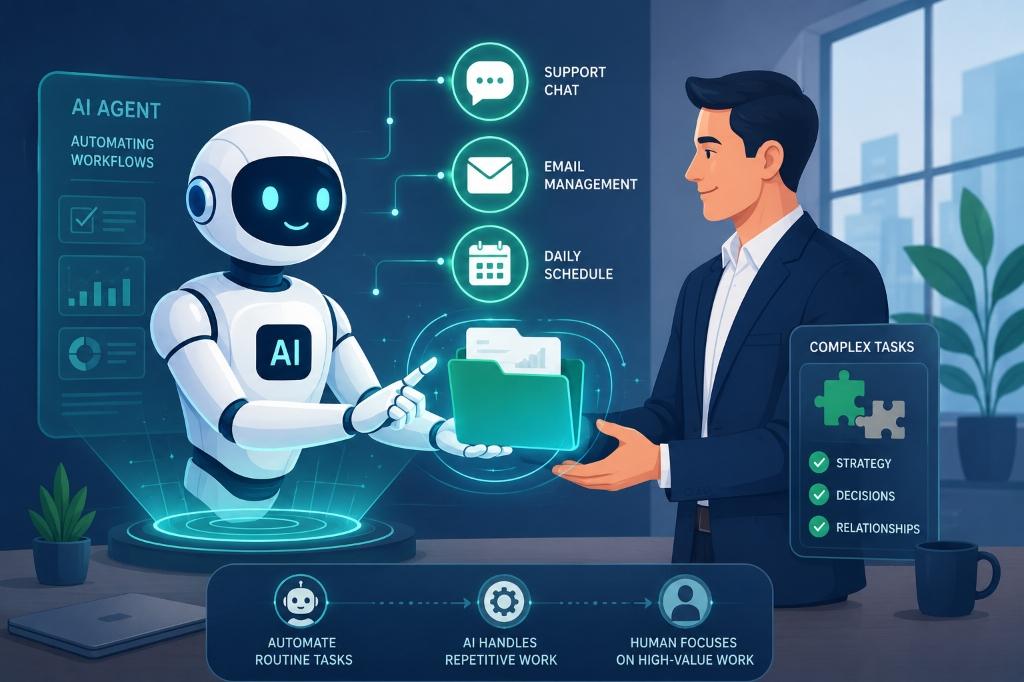
Artificial Intelligence has evolved from a simple search assistant into a powerful operational partner. Today, we are seeing the rise of autonomous AI agents—software tools capable of executing complex multi-step workflows, communicating with customers, and making decisions based on pre-defined guidelines.
In fact, modern statistics show that up to 80% of routine customer support queries are now handled entirely by AI.
For entrepreneurs and managers, integrating AI agents for business offers an unprecedented opportunity to automate administrative overhead. However, the key to success lies in understanding the limits of automation and knowing exactly when human intervention remains essential.
What Can AI Agents Automate Today?
Unlike traditional software that requires step-by-step instructions, AI agents are goal-oriented. You give them a goal (e.g., "Onboard this new customer"), and they execute the sub-tasks autonomously.
Here are the primary areas where AI agents excel:
- Customer Support Triage: AI agents can handle initial customer queries, answer FAQs, retrieve shipment statuses, and resolve standard complaints 24/7 without human delay.
- Administrative Workflows: AI can automate data entry between systems, summarize long reports, drafts standard emails, and coordinates schedules.
- Lead Qualification: AI chatbots can engage website visitors, answer basic product questions, qualify leads based on budgets or needs, and book meetings directly on your sales team's calendar.
By offloading these repetitive tasks, your human employees can shift their focus toward high-value growth activities.
The Hard Limit: Why the "Human Touch" Remains Vital
While AI can automate 80% of your customer interactions, the remaining 20% represent critical touchpoints that can make or break your business reputation.
AI models are pattern-matching engines; they do not possess genuine empathy, ethical reasoning, or creative problem-solving skills. Expecting AI to handle every customer scenario leads directly to frustrated clients and brand damage.
Human intervention is mandatory in three key areas:
1. Complex Problem-Solving
When a customer faces a unique, non-standard issue that does not fit into an FAQ template, an AI agent will get stuck in a loop. A human professional must step in to analyze the nuance and find a custom solution.
2. High-Stakes Negotiations & Relationship Building
No customer wants to close a major business contract or negotiate terms with a bot. Enterprise relationships, partnerships, and high-value sales require trust, active listening, and human connection.
3. Escalations & Emotional Conversations
If a customer is angry or upset due to a service failure, speaking with an automated system will only increase their frustration. These scenarios require human empathy, active apology, and dynamic decision-making authority.
How to Build a Hybrid Automation Workflow
To get the best results, you should combine the speed of AI with the judgment of your team:
- Deploy AI as the First Line of Defense: Let AI agents filter out simple queries and handle administrative tasks.
- Build Seamless Handoffs: Ensure that your AI tool is programmed to instantly hand off a conversation to a human team member if the sentiment turns negative or the query becomes complex.
- Equip Your Team with the Right Skills: As AI automates routine work, train your team to excel at customer relationship management, complex problem-solving, and working with AI tools to maximize their productivity.
By designing a hybrid workflow where AI handles the routine and humans handle the relationship, you can scale your operations efficiently while keeping your customers highly satisfied.