
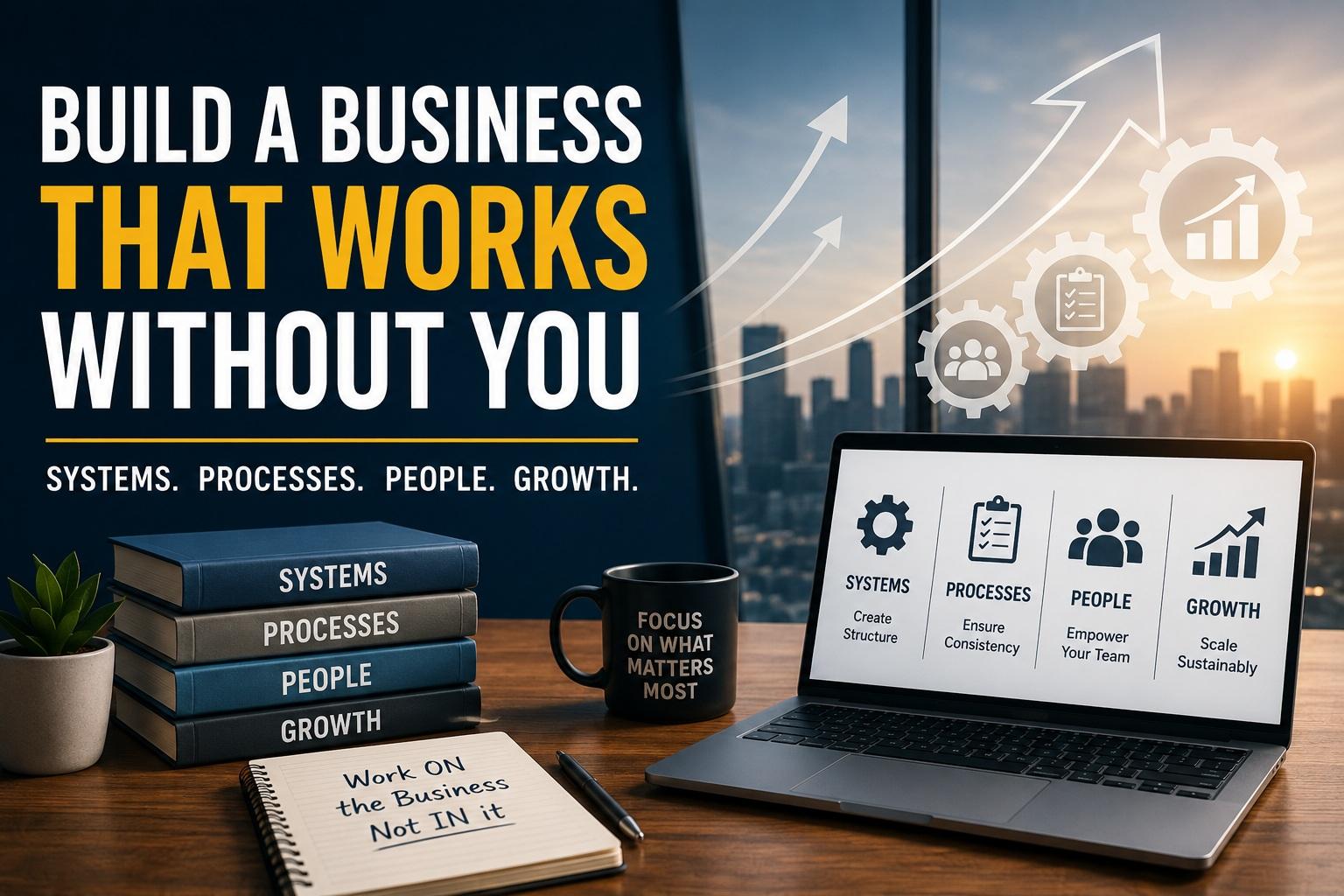
Many entrepreneurs dream of building a business that can run without their constant involvement. However, this concept is often misunderstood.
A business that works without you does not mean a business where the owner disappears completely and the money keeps flowing forever. In reality, every successful business needs leadership, direction, and strategic thinking. The difference is that as the business grows, the role of the owner should evolve.
The real goal is to create systems, processes, and teams that can handle day-to-day operations efficiently while the owner focuses on growth, mentoring, and long-term strategy.
In simple words, a business becomes scalable when systems make decisions instead of people.
Why Most Businesses Become Owner-Dependent
One of the biggest reasons businesses become dependent on their owners is that owners want to be involved in everything.
They approve purchases, negotiate with customers, handle complaints, review quotations, manage employees, and make every important decision themselves.
This approach may work when the business is small, but it eventually becomes the biggest obstacle to growth.
Many business owners believe that the problem is trust. They think employees cannot be trusted to make decisions.
I believe the real issue is not trust. The real issue is the absence of systems.
Instead of depending on trust alone, businesses should build processes that reduce errors, prevent misuse, and create accountability. When systems are properly designed, employees can make decisions confidently within defined boundaries.
The Danger of Centralized Decision Making
I once observed a company with a turnover of more than ₹2,000 crore where even the smallest purchases required approval from the Managing Director.
Whether it was a computer, a fan, or even a low-value office item, everything eventually landed on the Managing Director's desk.
At first glance, this may appear to be strong control. In reality, it creates bottlenecks.
When every decision depends on one individual, growth slows down. Employees stop taking ownership because they know the final decision will come from someone else. Managers become administrators instead of leaders.
A healthy organization requires a clear hierarchy.
Department heads should have authority limits. Purchasing teams should have defined responsibilities. Routine operational decisions should be handled by the people closest to the work.
Senior leadership should focus on strategic decisions, not on approving everyday expenses.
Growth Requires More Than Hard Work
Many entrepreneurs take pride in working long hours.
Hard work is important. In fact, every successful business owner has gone through periods of intense effort and sacrifice.
However, hard work alone does not create a scalable business.
The real question is whether your effort is creating long-term value.
If you spend every day solving the same problems repeatedly, your business remains dependent on your presence.
If you invest that same effort into building systems, training people, documenting processes, and improving efficiency, the business becomes stronger every year.
Hard work creates momentum.
Systems create scalability.
A successful business requires both.
The Three Foundations of a Scalable Business
If I were starting a new business today, I would focus on three critical areas from day one.
1. Product or Service Quality
Nothing can replace a strong product.
Whether you are selling physical products or professional services, quality should always remain a top priority.
A great product creates customer trust, repeat business, and long-term growth opportunities.
2. A Structured Sales Process
Many companies depend too heavily on a few talented salespeople.
A scalable organization develops a repeatable sales process that can be followed by multiple team members.
The sales process should define how leads are generated, how prospects are approached, how proposals are prepared, how follow-ups are conducted, and how opportunities are converted into customers.
When sales become process-driven rather than person-driven, growth becomes more predictable.
3. Strong Customer Relationships
Customer relationships are one of the most valuable assets any business can build.
Businesses that focus on customer satisfaction, responsiveness, and long-term value creation are more likely to generate repeat business and referrals.
Customer relationships often become the biggest competitive advantage in crowded markets.
Technology Is Changing the Rules of Business
Technology has become one of the most powerful tools available to entrepreneurs.
Today, businesses can automate activities that previously required entire teams.
CRM systems help manage customer interactions. ERP software improves operational efficiency. AI tools can assist with content creation, customer support, research, and business analysis.
In fact, we are now seeing the rise of solo entrepreneurs who manage significant operations with relatively small teams supported by technology.
Technology cannot replace leadership, but it can dramatically improve productivity and scalability.
Why Delegation Is Essential
Many business owners struggle with delegation.
Often, they expect employees to perform exactly like the owner from the very beginning. When employees make mistakes, the owner takes back control and becomes involved in every activity again.
This creates a cycle that limits growth.
Successful delegation starts with hiring people whose skills match the requirements of the role. Once employees are onboarded, they should receive proper training, clear expectations, and authority to make decisions within defined limits.
Delegation does not mean losing control. It is about understanding delegating authority to create a structure where responsibility is distributed while accountability remains measurable. According to research published by the Harvard Business Review's section on delegation, effective delegation is one of the most critical drivers of organizational efficiency and manager effectiveness.
The Importance of Backup Plans
A business should never depend entirely on one employee, one supplier, one customer, one product, or one strategy.
Every important activity should have a backup plan.
Unexpected events can happen at any time. Companies that prepare for disruptions before they occur are far more resilient than those that react only after problems arise.
Strong businesses are built with contingency planning in mind.
The Role of the Owner in a Mature Business
If a business reaches a significant scale, the owner should spend less time managing daily operations and more time mentoring teams, reviewing performance, identifying new opportunities, and driving business development.
The owner should focus on the future of the business rather than routine operational activities.
That is where the greatest value can be created.
Final Thoughts
Every entrepreneur wants growth, but growth without systems eventually creates chaos.
The businesses that achieve sustainable success are not built around one individual. They are built around strong processes, empowered teams, clear responsibilities, effective technology, and continuous improvement.
Owners should certainly work hard, especially during the early stages of building a business. However, that hard work should be directed toward creating systems that continue delivering results long after the initial effort is complete.
Ultimately, the most scalable businesses are those where people follow systems, teams take ownership, and decisions are guided by processes rather than personalities.
A business becomes truly scalable when systems make decisions instead of people.